

South American camelids in Peru: how to tell llamas, alpacas, vicuñas and guanacos apart on your trip
There are two things that almost always happen when people travel to Peru for the first time. First, they fall for the landscapes way too fast. Second, they start calling every long-necked, soft-looking Andean animal an alpaca. And honestly, fair enough. When you’re moving between Lima, Cusco, the Sacred Valley, markets full of textiles, mountain viewpoints, and dreamy travel photos everywhere, it is very easy to mix them up. From a distance, llamas, alpacas, vicuñas, and guanacos can look like variations of the same iconic Andean animal. But once you slow down and pay attention, you realize they each have their own look, their own vibe, their own role in Peruvian culture, and their own place in the story of the Andes.
That is why learning about South American camelids in Peru is not just one of those random facts you memorize to sound smart on a tour. It genuinely makes your trip better. It changes how you look at the country. Suddenly, a textile shop is not just full of soft sweaters and scarves. A mountain stop is not just a photo break. A cultural visit is not just a performance for travelers. You start seeing connections between landscapes, animals, communities, and traditions. And for a young traveler doing a Peru travel guide style route through Lima and Cusco, those details are exactly what make the experience feel richer and way less surface-level.
If you are wondering which South American camelids travelers can actually find in Peru, the answer is simple: llama, alpaca, vicuña, and guanaco. These four animals are the stars of the camelid family in the Andes, and Peru is one of the best places to get to know them. Two of them are domestic animals and are much more closely linked to everyday life, local tourism, and traditional production. Two are wild animals and feel more tied to conservation, high-altitude ecosystems, and a more distant kind of beauty. That difference matters, because it explains not only how they look, but also where you are most likely to see them during your trip.
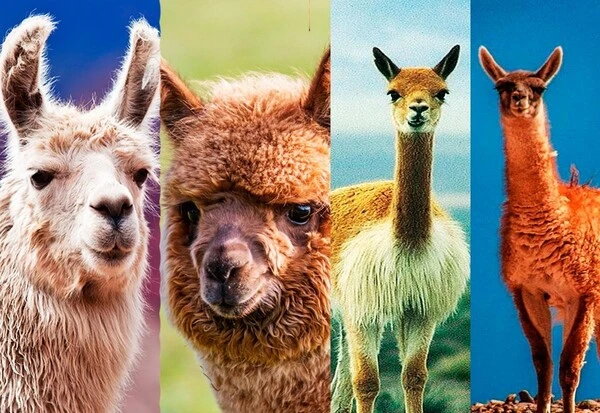
The llama is probably the most recognizable Andean camelid once you know what you are looking at. It has main-character energy. Bigger than an alpaca, taller, more elongated, and usually less fluffy overall, the llama looks like it belongs in the mountains in a very confident way. It has that classic silhouette that instantly reads “Andes,” even for people who do not know much about Peru yet. If the alpaca looks like it was made to inspire cozy winter fashion and soft Instagram posts, the llama feels more like the experienced backpacker of the group: resilient, unfussy, and fully at home in tough terrain.
One of the coolest things about llamas is that their fame is not just about aesthetics. They were historically important pack animals in Andean life, which means they were part of movement, trade, transport, and adaptation in mountain environments long before modern tourism showed up. That gives them a different kind of presence. When you see a llama in Peru, you are not just looking at a cute animal grazing somewhere scenic. You are looking at a living link to centuries of life in the Andes. That historical role is part of why llamas feel so deeply woven into the visual identity of Peru. They are not just decorative. They are cultural.
If you want a quick llama vs alpaca trick, start with size and body shape. A llama is usually taller and more athletic-looking than an alpaca. Its face tends to be longer, its body more stretched, and its overall silhouette more upright. It can still look adorable, obviously, but it usually looks less like a giant cloud and more like a mountain animal that takes itself seriously. Once you see a llama and alpaca next to each other, this difference becomes much easier to spot, and after that, you will probably stop calling everything an alpaca forever.
Now let’s talk about the alpaca, because yes, this is the one most travelers are secretly hoping to see. And it makes sense. Alpacas are incredibly photogenic. They are smaller than llamas, usually look rounder in the face, and have the kind of soft, fluffy fiber that instantly makes you think of warm scarves, knitwear, and all the textiles you suddenly want to buy in Cusco even if your backpack is already too full. If the llama gives trekking energy, the alpaca gives cozy energy. It is the unofficial face of cute Peru.
But there is more to alpacas than being camera-ready. Alpacas are deeply important in Peru because of their fiber, which is one of the country’s best-known natural materials and a huge part of Andean textile culture. That is why, when you walk through craft markets or see stores specializing in alpaca products, this animal shows up everywhere in the branding, the illustrations, the souvenirs, and the storytelling. It is not just because it looks nice. It is because alpacas are tied to an entire world of weaving, craftsmanship, and local identity. So when young travelers say they want a more authentic Peruvian culture experience, learning how alpacas connect to that bigger story is actually a great place to start.
There is also something very satisfying about realizing that alpacas are not just “small llamas.” They have a different body language. They often look more compact, softer, and more rounded overall. Their fiber is much more prominent, and that texture makes a huge visual difference. If you see an animal that looks extra fluffy, extra plush, and generally more like it belongs on a very fancy blanket than hauling supplies through the Andes, there is a good chance you are looking at an alpaca. This is also one reason why alpacas are so often the favorite Andean animal for first-time travelers in Peru. They are easy to love.
Then there is the vicuña, and this is where things get more elegant and a little less obvious. Vicuñas are wild camelids, not domestic ones, and they carry themselves that way. They are lighter, finer, slimmer, and much more delicate-looking than llamas or alpacas. If alpacas are soft and llamas are sturdy, vicuñas are graceful. They have long legs, a lean body, and a kind of alert beauty that feels very different from the more approachable look of domestic camelids. A vicuña does not really give off “come take a selfie with me” energy. It looks like it was designed for open highland landscapes, speed, and distance.
That is part of what makes vicuñas so fascinating for travelers. They are not famous only because they are beautiful. They are also powerful symbols of Peruvian natural heritage. Once you know how to spot one, seeing a vicuña feels different from seeing an alpaca in a tourist setting. It feels more special, more like you are getting a glimpse into the wild side of the Andes rather than the domestic or cultural side. Their beauty is more refined than cuddly. They are the kind of animal that makes you stop, lower your voice a little, and actually observe instead of just taking a quick photo and moving on.
A lot of travelers confuse vicuñas with alpacas at first, and honestly, that happens all the time. But once you compare them, the differences start to stand out. A vicuña is slimmer, less fluffy, more delicate in the face and legs, and clearly more wild in the way it holds itself. It does not look built for the same relationship with humans that alpacas have. So if you are wondering how to tell llamas, alpacas, vicuñas, and guanacos apart, the vicuña is the one that looks almost like the elegant minimalist version of the whole family.
And then we get to the guanaco, which might be the least famous of the four for the average traveler in Peru, but is easily one of the most interesting. Guanacos are also wild camelids, and they have a more rugged, understated beauty than vicuñas. They are not as fluffy as alpacas, not as familiar-looking as llamas, and not as instantly iconic in tourism imagery as vicuñas. Because of that, they often get overlooked. But once you notice one, you start to appreciate how different it really is. Guanacos usually have a more sober look, with earthy tones, an athletic body, and a strong sense of wildness.
The guanaco does not really try to be charming in the same obvious way an alpaca does. It is the kind of animal you appreciate more the longer you look at it. It feels adapted to harsher landscapes, more like a true wild survivor than a cultural icon turned travel mascot. And that is exactly why it matters. The guanaco completes the picture of South American camelids in Peru. If you leave Peru knowing only llamas and alpacas, you understood the cute part. If you also recognize vicuñas and guanacos, you understood something much deeper about the Andean environment.
So how do you actually remember the difference between all four without opening your phone every five minutes during your trip? The easiest trick is to focus on size, fluffiness, and attitude. Llama: bigger, taller, more elongated, and usually more confident around people. Alpaca: smaller, fluffier, rounder, softer-looking. Vicuña: elegant, slim, refined, and clearly wild. Guanaco: wild too, but more rugged, earthy, and athletic than the vicuña. That simple framework is not a full biology class, but it works really well for travelers. Once you hold those four ideas in your head, your chances of mixing them up drop fast.
And this is where your itinerary becomes important, because knowing the theory is one thing, but seeing these animals in real life is what actually trains your eye. Most travelers assume this kind of experience starts only once they get to Cusco or deeper into the Andes, but Lima can actually be a really useful first stop if you want to understand Peru’s camelids properly. For many people, Lima is all about food, nightlife, ocean views, neighborhood walks, and adjusting to the country before heading south or into the mountains. But it can also be the beginning of your camelid education.
One of the easiest places to start is the Parque de las Leyendas, which is a practical option if you want to compare species in a more controlled setting before heading to the highlands. This works especially well if you have just arrived in the capital and want to do something different from the classic Miraflores circuit. Seeing camelids in Lima might sound unexpected at first, but it gives you a huge advantage later. When you reach Cusco, the Sacred Valley, or other Andean areas, you will already have a much better eye for what you are looking at.
That matters because travel moves fast. In Cusco, you are usually juggling altitude, tours, ancient sites, transport, viewpoints, markets, and a lot of excitement. It is easy to see an animal and just register “cute alpaca” before running to the next stop. Lima gives you a slower entry point. It lets you look more carefully. If you are especially interested in spotting a vicuña or understanding how a guanaco differs from a llama, that first visual reference can be incredibly helpful. In that sense, seeing camelids in Lima is not random at all. It can be one of the smartest warm-up plans for the rest of your trip.
Then comes Cusco, and this is where everything clicks. If Lima helps you identify, Cusco helps you connect. The region is packed with visual and cultural cues that make camelids feel fully part of the travel experience. Between mountain landscapes, woven textiles, village visits, markets, and Sacred Valley routes, these animals stop being abstract and start feeling woven into the whole logic of the place. If you want one of the best places to compare all four South American camelids in Cusco, Awana Kancha is a very strong option.
What makes Awana Kancha so good for young travelers is that it does not feel like a dry educational stop. It connects animals with textile traditions and makes the whole thing more visual, more tangible, and more relevant to the kind of Peru trip most backpackers are already dreaming about. You see llamas, alpacas, vicuñas, and guanacos, but you also start understanding how these animals fit into weaving, fiber production, local economies, and the wider idea of Andean culture. That combination is exactly what makes the experience work. It is not just about learning names. It is about seeing relationships.
And that relationship between camelids and textiles is one of the most underrated parts of traveling through Peru. A lot of people buy knitwear or souvenirs without really knowing what animal, tradition, or material story sits behind the product. But when you have seen alpacas up close, when you understand why vicuñas are so special, and when you recognize the historical role of llamas, the whole textile world makes more sense. It stops feeling like generic tourist shopping and starts feeling like part of the place. For a lot of travelers in their twenties, that is exactly the sweet spot: still fun, still visual, still easy to enjoy, but with way more meaning.
Cusco also gives you a bonus camelid moment that many travelers already have on their bucket list without fully realizing it: llamas in Machu Picchu. Yes, those iconic photos are real. Seeing a llama wandering around one of the most famous archaeological sites on the planet is one of those travel moments that somehow feels both surreal and totally right. If Machu Picchu is part of your route, the Backpacker Guide to Machu Picchu & the Sacred Valley is a great internal read to help you plan that part of the journey. Machu Picchu is not the place to study every camelid side by side, but it can easily become the place where your most memorable llama sighting happens.
Alpacas, meanwhile, are almost impossible to separate from the wider Cusco experience. Not because they are casually hanging out on every corner, but because the region is so connected to textile culture, artisan spaces, and mountain imagery that the alpaca becomes part of the atmosphere. You see it in products, in visual identity, in experiences, and in the stories people tell about the Andes. That is why alpacas are often the animal travelers remember most vividly after visiting Cusco. They are cute, yes, but they are also deeply linked to what people imagine when they think about the region.
Vicuñas and guanacos require a more realistic expectation. If your dream is to see them just wandering around central Cusco or popping up randomly during every tourist route, that probably will not happen. These are not the camelids most casual travelers encounter in the easiest, most spontaneous way. That is why places designed to help visitors understand them are so useful. If your goal is not just to see one fluffy animal and move on, but to actually learn the differences between llama, alpaca, vicuña, and guanaco, the best strategy is still to combine a Lima stop with a Cusco stop. That way, you are not depending on luck.
This is also why the topic works so well for backpacking Peru content. It speaks to curiosity, culture, animal life, iconic visuals, and route planning all at once. Someone searching for “South American camelids in Peru,” “llama vs alpaca,” “where to see alpacas in Cusco,” or “things to do in Lima and Cusco” is not always looking for a scientific explanation. Often they are looking for context that helps the trip feel more alive. They want something useful, something memorable, and something that fits the actual rhythm of how people travel. Camelids are perfect for that because they sit right at the intersection of culture, nature, and experience.
And honestly, that is one of the best parts of travel in Peru. So much of the country works on different layers at the same time. You can be taking a great photo and also learning something real. You can be having a fun, spontaneous day and also gaining a better understanding of local culture. You can start by joking that all these animals look the same and end up leaving with a pretty sharp eye for differences. That shift might sound small, but it is the kind of detail that makes a trip stay with you longer. It is the difference between just passing through and actually noticing where you are.
If you are planning your route from the coast to the mountains, staying at Pariwana Lima can be a good way to settle into the city before moving on to higher altitude. From there, the Lima Travel Guide for Backpackers helps you organize the capital beyond the obvious highlights and build a more interesting start to your Peru trip. Later, once you head south, the Cusco Travel Guide for Travelers becomes really useful for shaping the mountain leg of the journey around culture, day trips, and practical planning. And if you want to connect everything into a bigger route, the Backpacker’s Guide to Peru is the kind of internal guide that helps turn separate stops into one more coherent adventure.
You could also make the argument that learning camelids is one of the easiest ways to become a more observant traveler in Peru. It teaches you to look twice. To compare. To notice details instead of just consuming the destination in quick flashes. A llama is not just the tall one. An alpaca is not just the fluffy one. A vicuña is not just the elegant one. A guanaco is not just the forgotten one. The more you look, the more each animal starts to feel like a different way into the Andes. One leads you into history. One into textiles. One into conservation. One into the broader ecology of South America. That is a lot of depth from four animals people often treat like variations of the same plush toy.
There is also something quietly satisfying about becoming the person in your group who actually knows the difference. Travel is full of these tiny upgrades in perception. One day you are confused. The next day you are pointing at a hillside and saying, “That one is a llama, that one’s an alpaca, and no, that is definitely not the same thing.” It is a small win, but it feels good. And it makes the destination feel less generic. Peru is already powerful because of its landscapes, history, and food, but these smaller layers of knowledge are what make the whole trip feel fuller, especially for travelers who want more than just checklist tourism.
So next time you see a long neck against a mountain backdrop in Peru, do yourself a favor and do not say “alpaca” automatically. Pause for two seconds. Look at the size. Look at the face. Look at the fiber. Look at the attitude. Ask yourself whether you are looking at the sturdy confidence of a llama, the soft charm of an alpaca, the elegant wildness of a vicuña, or the rugged reserve of a guanaco. That tiny pause changes everything. It turns a photo into an observation, an observation into curiosity, and curiosity into a better kind of travel.
And that, really, is the whole point. The best Peru trips are not just the ones with the best photos or the most famous stops. They are the ones where the country starts revealing its little details to you. The ones where a market, a mountain road, a woven scarf, or an animal in the distance suddenly carries more meaning than it did an hour ago. South American camelids are a perfect example of that. They are beautiful, yes. They are iconic, absolutely. But more than that, they are an invitation to see Peru more clearly. And once that happens, the trip starts feeling less like a highlight reel and more like a real connection.
So whether you first meet them in Lima, recognize them properly in Cusco, or finally stop mixing them up halfway through the Sacred Valley, llamas, alpacas, vicuñas, and guanacos are worth paying attention to. They are part of Peru’s visual identity, part of its cultural memory, part of its wildlife story, and part of what makes traveling here feel so unique. Learn the difference, enjoy the process, and let that small shift in perspective open the door to a much more interesting version of the country.
✍️ Pariwana Editorial Team
Practical travel tips written by backpackers, for backpackers.
A practical guide to negotiating prices in local markets and taxis without being disrespectful.